
One bot. Or a bench of them.
Viktor made the case for an AI coworker before we did, and the category is better for it. The difference we would ask you to test: Michael is a multi-bot experience that works your jobs in parallel. Viktor is one bot, working one job at a time.
Nobody wins this on a feature list.
Both products live in Slack. Both connect to your stack. Both hand back files instead of advice. If you compare the two homepages you will find mostly the same promises, which is why we are not going to spend this page arguing about tool counts. The difference we would ask you to test is what happens when you give either one three jobs at once. Michael answers with a bench of bots working in parallel. Viktor answers with one bot and a queue.
You @ him like anyone else on the team. Underneath he is a bench of bots, not one: hand him three jobs and three workers pick them up in parallel, each with its own ETA. He remembers your taste, not just your thread.
The other product in this category built on the same idea. One bot you message rather than a tool you operate, connected to your stack, working one job at a time.
The three questions worth asking.
Read the reply, not the feature list.
When two products do the same thing, the tiebreaker is the one you cannot screenshot: how it talks to you when the work is done.

Audit our Meta and Google spend for May, month over month.
Pulling the numbers now. ETA 4 min.
Done. Meta CPA is down 12% and ROAS is up to 3.4x. Google pMax is underperforming. I flagged 3 campaigns to pause in the doc.
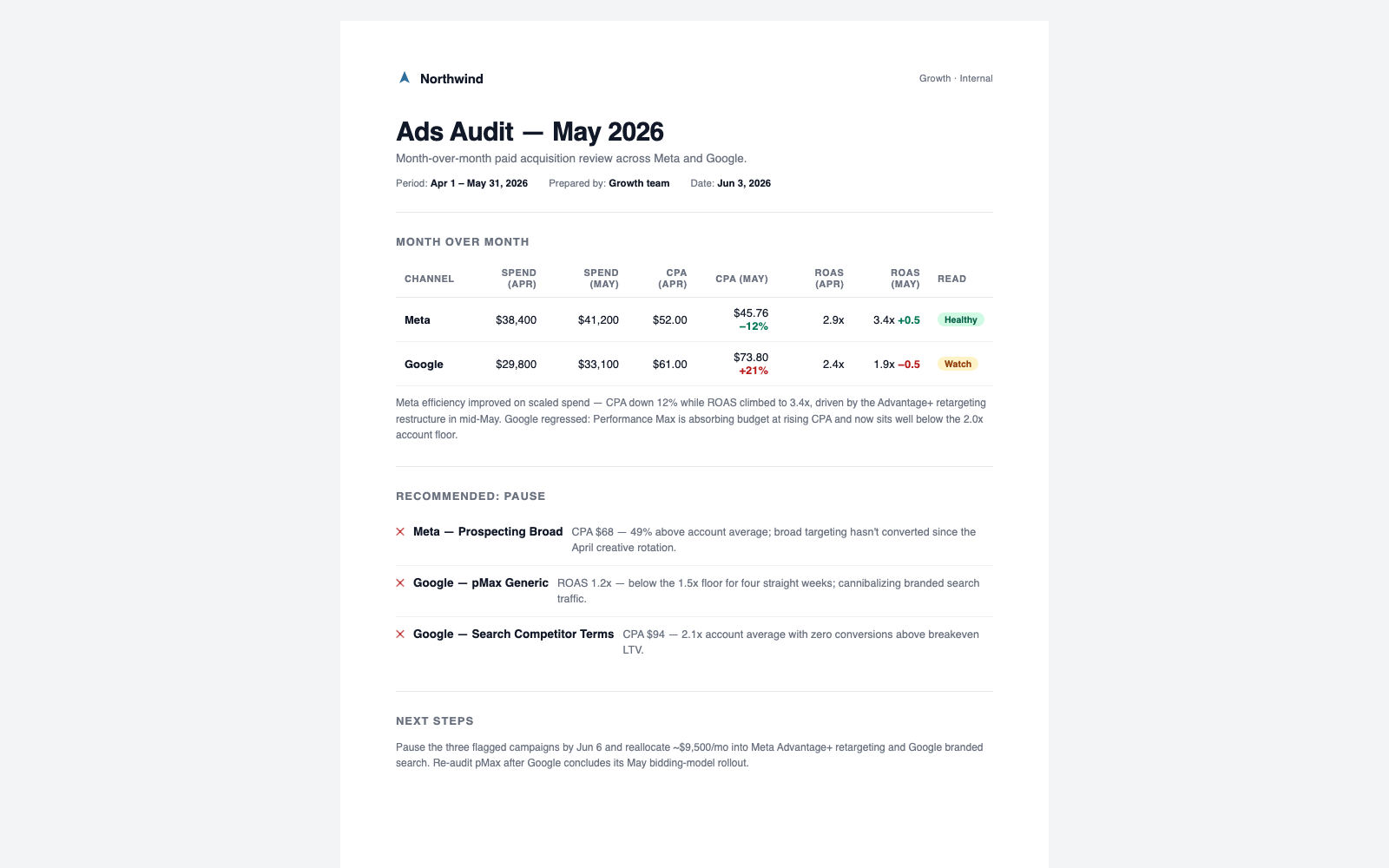
Three lines, an ETA, and the file, with two more jobs running alongside it. No preamble, no restating the request back at you, no queue. Run the same asks past both products at the same time and keep the one whose replies you would forward to your cofounder without editing them.
Line by line. Honestly.
Half these rows are things we believe about our own product and only think about theirs. Treat the Viktor column as the shape of the question to ask on their trial, not as a spec sheet we can vouch for. The rows we would actually run a trial on are parallel load, memory, and price.
Both are fast. That is the category.
Neither of these is a six-week integration project, and any comparison page that tells you otherwise about the other one is selling you something.
- Add Michael to Slack.
- Connect Stripe, Gmail, and one ads account.
- Give him a job.
- Add it to Slack.
- Connect your tools.
- Give it a job.
What that looks like on a real team.
One customer, the two numbers they measured, and what they said about it.
“The time and money savings of Michael have been incredible. My team is able to operate at a far greater velocity now, enabling us to hit aggressive targets in market expansion.”

Where Viktor is the better call.
This is the section where a comparison page usually gets thin. We are going to try harder than that, because you can go and check.
A longer track record, more customers who have already hit the edges, and a support team that has answered your question before. On a category this young that is worth real money.
Go and read it. If the three systems your company actually runs on are all on their page today and one of them is missing from ours, that settles it and you should not overthink it.
Switching costs are real. If half your company has a working habit with Viktor, the marginal gain has to beat the cost of breaking that habit, and often it will not.
What each one actually costs.
We list our prices here because they are ours. Go and read theirs on their own page rather than trusting a competitor's summary of it, including ours.
- Starter $19, Pro $99, Max from $199.
- Every plan connects tools and ships artifacts.
- Every plan runs jobs in parallel, not in a queue.
Viktor- Priced by Viktor, per seat, by tier.
- We are not going to quote a competitor's price back at you.
- Compare the entry tier, not the headline one.
Pick the one that fits.
- You want to hand over three jobs and get three back, worked in parallel.
- You want a bench of bots behind one name, not a single bot with a queue.
- You want the second month to be better than the first.
- You care how the replies read, because your team reads them.
- You want to start at $19 rather than at a sales call.
- Their integration list covers your stack today and ours does not.
- Your company runs on Teams. We do not support it and they do.
- Your team already has the habit.
- A longer track record is what you are buying.
- You tried both and preferred theirs. That is a real answer.
Short answers.
Why is this page softer than most comparison pages?
How should I actually decide?
What does multi-bot actually mean?
Can I move if I picked wrong?
What does Michael see in my Slack?
Run them both. Same week, same jobs.
Three real tasks, handed to each at the same time. Watch how many move at once, read what comes back, and pick on that, not on either homepage.