

Grok reads the room. Michael clears the desk.
One is built around the public conversation, live, as it happens. The other is built around your private stack and the six things you have not got to yet.
Two products, two different jobs.
This is the least head-to-head of our comparison pages, and we would rather say so than pretend otherwise. Grok is at its best on the live public conversation and has a voice that will happily disagree with you. Michael is at his best on the private, unglamorous, cross-tool work that nobody outside your company will ever read.
You @ him like anyone else on the team. He connects to your stack, owns the task from ask to artifact, and stops to confirm before doing anything he cannot undo.
xAI's assistant, closest to home inside X. Fast, current, unusually willing to have an opinion, and strongest on what the world is saying this hour.
Different question. Different answer.
The unglamorous work is still the work.
Nothing about this exchange is interesting to the internet. It is four tabs of reconciliation that somebody on your team was going to lose a morning to.

Audit our Meta and Google spend for May, month over month.
Pulling the numbers now. ETA 4 min.
Done. Meta CPA is down 12% and ROAS is up to 3.4x. Google pMax is underperforming. I flagged 3 campaigns to pause in the doc.
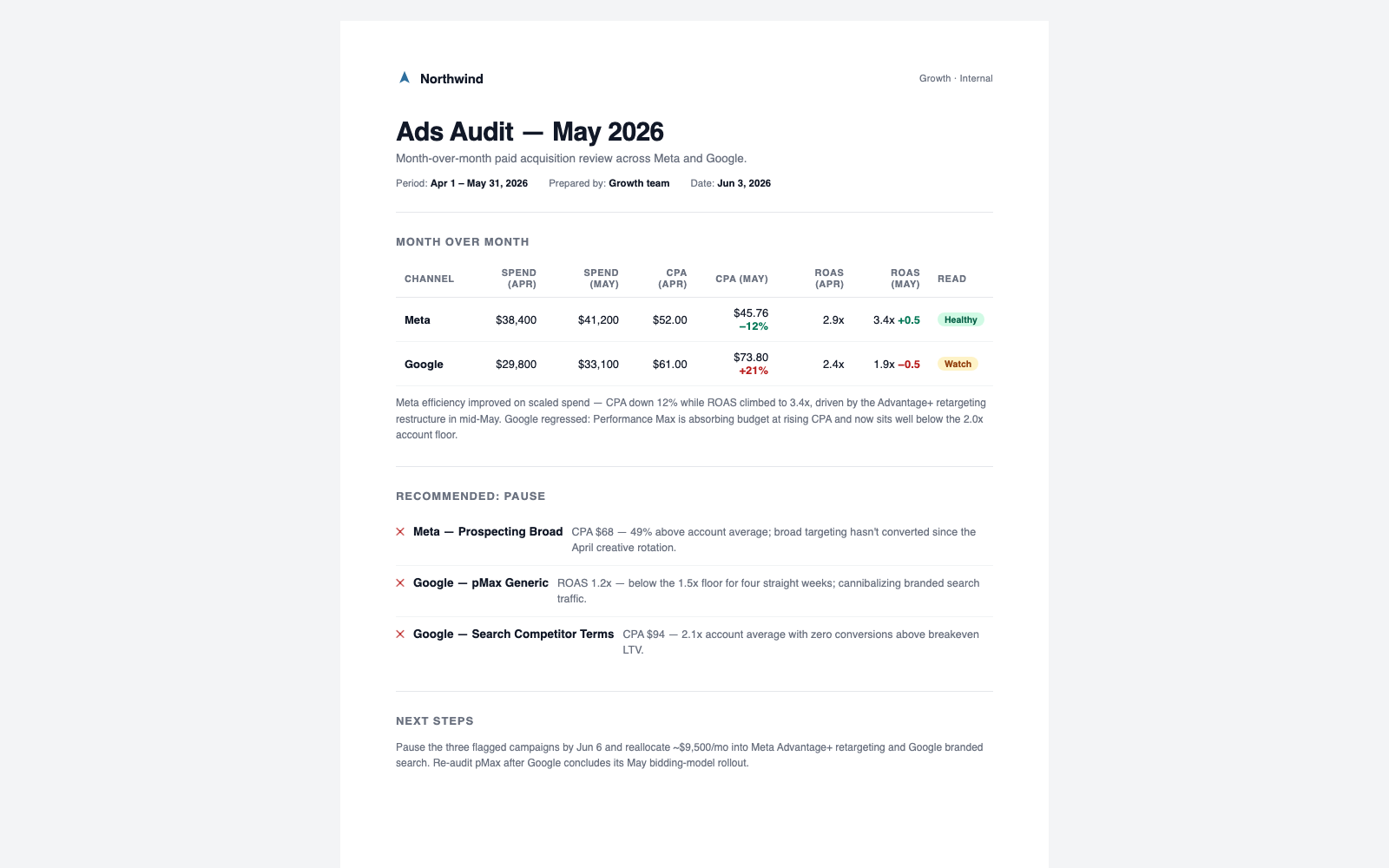
No model can do this from the public internet, however current it is. It needs credentials to two ad accounts, a decision about what counts as underperforming, and a document at the end.
Line by line. No asterisks.
Read the first row and the rest follows. These are not competing answers to one question. They are answers to two different questions, and most teams have both.
Three steps, or a login.
Grok wins this section outright, and it should. Signing in is not a project. It is also not a connection to your stack.
- Add Michael to Slack.
- Connect Stripe, Gmail, and one ads account.
- Give him a job.
- Sign in.
- Ask.
- Bring your own data every time after that.
What that looks like on a real team.
One customer, the two numbers they measured, and what they said about it.
“The time and money savings of Michael have been incredible. My team is able to operate at a far greater velocity now, enabling us to hit aggressive targets in market expansion.”

Where Grok is the better call.
We would rather you trust this page than convert off it.
What is the reaction to this launch, what is the argument about this morning, who is saying what. Real-time signal on the public conversation is a genuine edge and Michael does not compete for it.
Grok will push back, and some people work better against something that pushes back. Michael is direct but he is a colleague, not a sparring partner.
If your marketing, your audience, and your feedback loop are all in one place, the assistant that lives there has a head start nothing else can borrow.
What each one actually costs.
These are not substitutes, so the honest read is not which is cheaper. It is which line item is buying you time back.
- Starter $19, Pro $99, Max from $199.
- Every plan connects tools and ships artifacts.
- Buys back the hours the four-tab jobs take.
Grok- Priced by xAI, per seat, by tier.
- Bundled with the X tiers that include it.
- Buys you the fastest read on what just happened.
Pick the one that fits.
- The work crosses your private tools and ends in a file.
- You want jobs finished while you do something else.
- Your team lives in Slack.
- You want the same job to run every Monday without asking.
- Nobody on the team has time to be the integration layer.
- Your question is about the public conversation, live.
- You work on X and want the assistant that lives there.
- You want an assistant that argues back.
- Speed of answer matters more than finish of output.
Short answers.
Is this even a fair comparison?
Can I use both?
Which models does Michael use?
What does Michael see in my Slack?
Will he post anything publicly?
Give him the boring one. See what comes back.
Pick the task with four tabs and no glamour in it. That is the one Michael is for.