
Claude answers. Michael ships.
Both live in your Slack. One gives you the best thinking in the room. The other goes away, works your tools, and comes back with the finished file.
One is a thinking partner. One is a hire.
The question is not which model is smarter. It is whether you want a brilliant assistant in the thread with you, or a coworker who takes the task off your plate and comes back when it is done. Plenty of teams want both. If you only have room for one hire this quarter, this is the page about which one it should be.
You @ him like anyone else on the team. He connects to your stack, owns the task from ask to artifact, and stops to confirm before doing anything he cannot undo.
Anthropic's assistant, available in Slack as an app you @ in a thread. It reads the conversation, reasons about it, and answers in place.
Same @ mention. Different hire.
The artifact is the product.
Ask a great assistant to audit your ad spend and you get a great explanation of how to audit ad spend. Ask Michael and you get this.

Audit our Meta and Google spend for May, month over month.
Pulling the numbers now. ETA 4 min.
Done. Meta CPA is down 12% and ROAS is up to 3.4x. Google pMax is underperforming. I flagged 3 campaigns to pause in the doc.
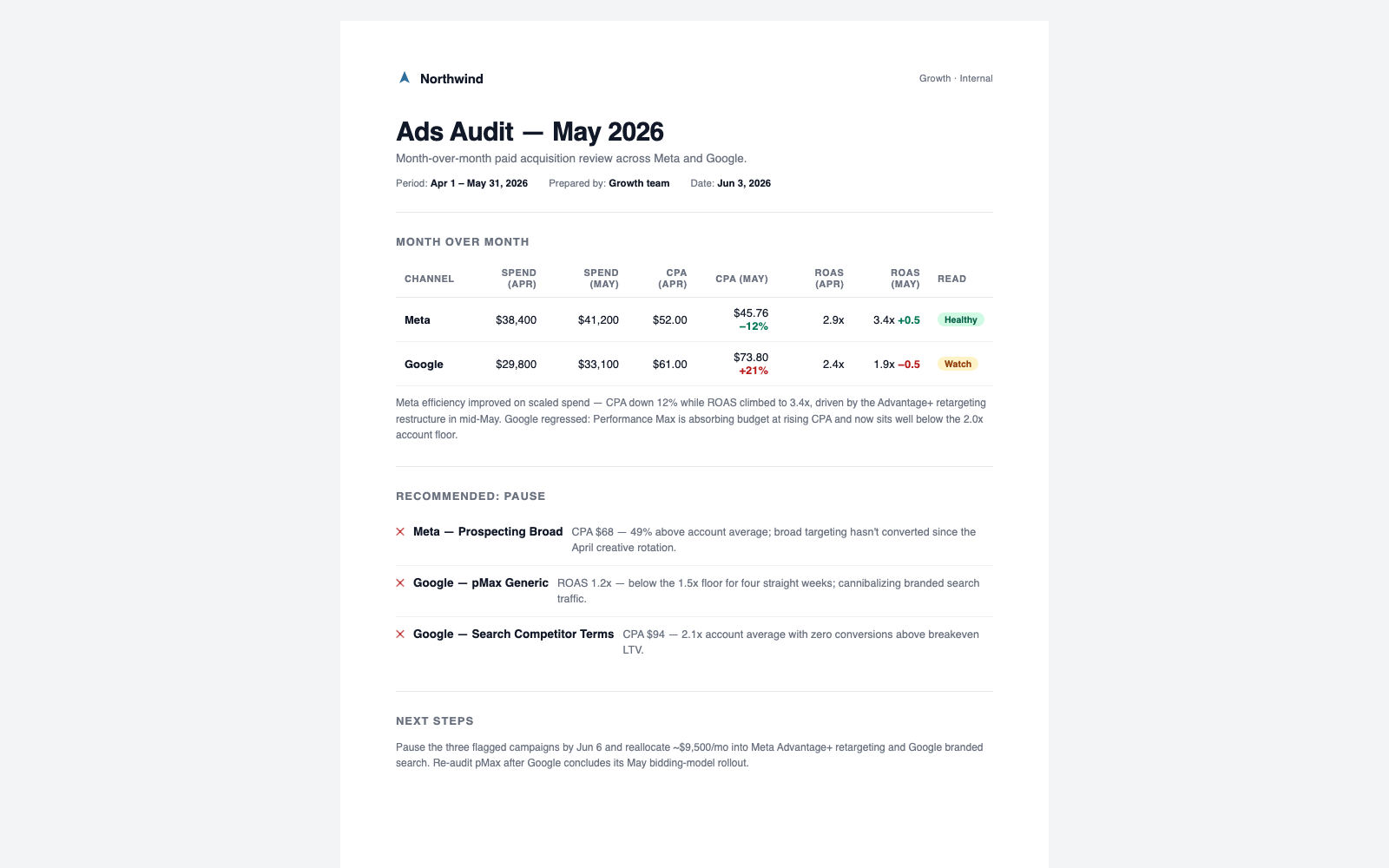
Two lines of chat. The work is the attachment. That gap is not intelligence, it is finish: somebody still has to open the tools, pull the real figures, and lay them out in something you can forward.
Line by line. No asterisks.
The row that compounds is memory. The second time you ask a coworker for the weekly numbers, you do not re-explain what the weekly numbers are. Michael knows which Stripe account is the real one and that you told him the CAC line was wrong. Thread-scoped context is the right design for an assistant and the wrong one for a hire.
Three steps, or a project.
This is the gap most teams feel first. Not intelligence. Wiring.
- Add Michael to Slack.
- Connect Stripe, Gmail, and one ads account.
- Give him a job.
- Confirm your Anthropic plan covers the Slack app.
- Get a workspace admin to install it.
- Connect the accounts you want it to see.
- Build or host MCP servers for anything the connectors miss.
- Keep someone maintaining that as tools and APIs move.
What that looks like on a real team.
One customer, the two numbers they measured, and what they said about it.
“The time and money savings of Michael have been incredible. My team is able to operate at a far greater velocity now, enabling us to hit aggressive targets in market expansion.”

Where Claude is the better call.
We would rather you trust this page than convert off it.
Hard architecture calls, thorny legal reading, a strategy you need pressure-tested. Talking straight to a frontier model, at length, is the right shape for that.
Summarize this argument, draft this reply, unpick this spec. When the context is the conversation and the output is text, answering in place wins.
Claude Code is excellent. And if you already have the vendor relationship, the security review, and the bill, adding another one has a real cost.
What each one actually costs.
The line worth reading is the last one on each card.
- Starter $19, Pro $99, Max from $199.
- Every plan connects tools and ships artifacts.
- Setup cost: about three minutes.
Claude- Priced by Anthropic, per seat, by tier.
- The Slack app comes with the plan that includes it.
- Setup cost: whatever your connectors take, forever.
Pick the one that fits.
- You want work finished, not explained.
- The task crosses three tools and you own all three.
- You are a founder or a lean team with nobody to hand this to.
- You want the same job to run every Monday without asking.
- You do not want to maintain connectors.
- Your best use is thinking, writing, and reviewing.
- The work starts and ends inside the conversation.
- You have engineers who enjoy owning the integration layer.
- One vendor and one security review matters more than breadth.
Short answers.
Is Michael built on Claude?
Can I use both?
What does Michael see in my Slack?
Will he email a customer without asking?
We already pay for Anthropic. Why add this?
Give him a real job. See what comes back.
Pick the task you have been putting off. The one that means four tabs and reconciling numbers by hand. Hand it to Michael and read the reply.